Overview
Thank you for your interest in the Extension Master Food Volunteer program! This page provides information about the program. If you'd like to learn whether the EMFV program is offered in your county, please see the bottom of this page, or contact Morgan Marshall, morgan_marshall@ncsu.edu. Thank you!
What is the Extension Master
Food Volunteer Program?
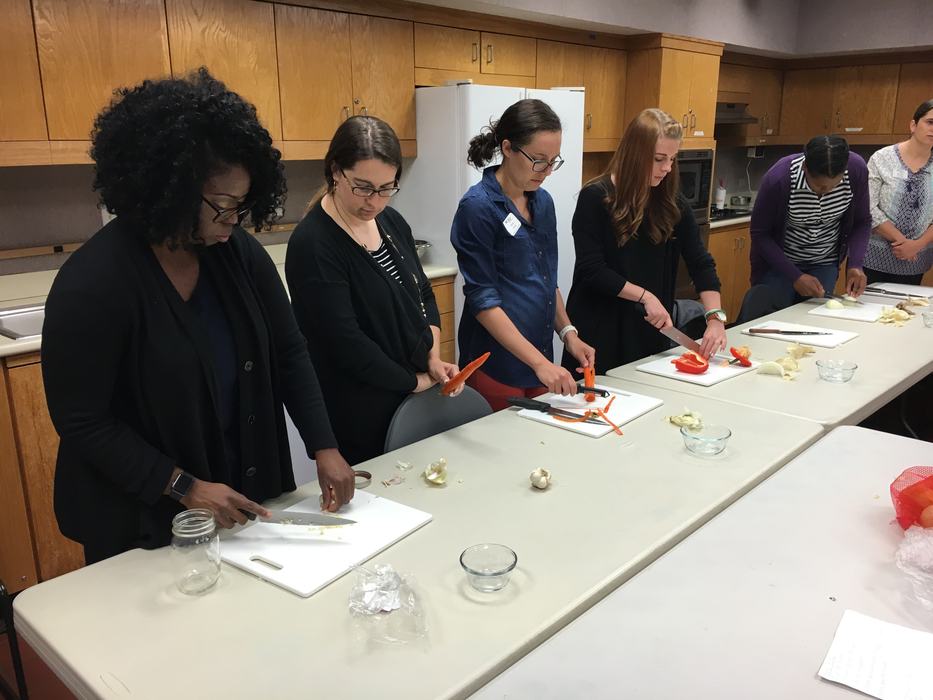
Interest in food, cooking, and local food is at an all-time high. The Extension Master Food Volunteer (EMFV) program is designed to engage residents in food and nutrition programming in their community and train volunteers to further expand the reach of N.C. Cooperative Extension. The EMFV program will allow FCS agents to train volunteers to support their food and nutrition programming and promote local food, thereby building their capacity to deliver high quality, evidence-based interventions.
What types of activities do volunteers support?
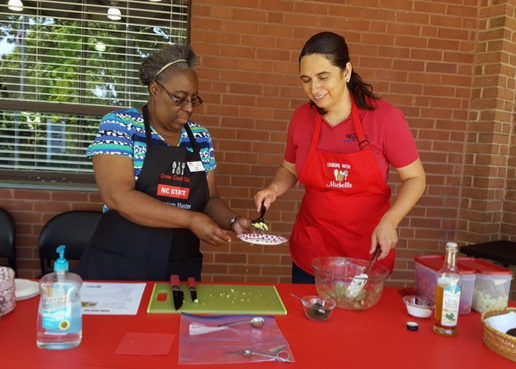
Volunteers work closely with their supervising FCS agent to deliver Cooperative Extension nutrition education and cooking programs, such as Steps to Health, Faithful Families, Cook Smart Eat Smart, and Med Instead of Meds. In addition, volunteers assist with community-based programs and outreach, including food preservation classes, lunch n’ learn workshops, cooking demonstrations at community locations (such as farmers' markets and food pantries), kids cooking camps, and community health fairs.
What are some of the logistics of the EMFV program?
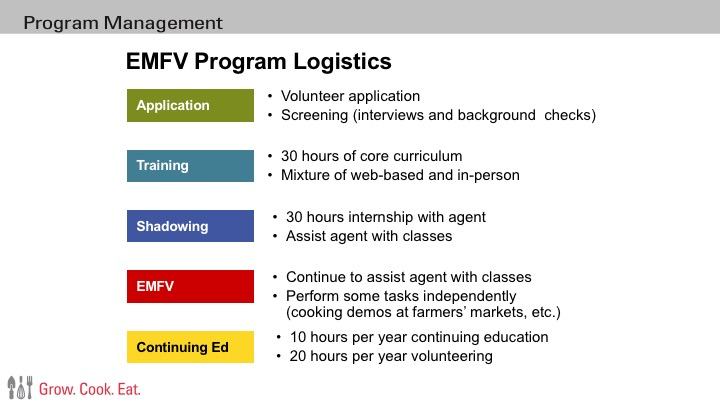
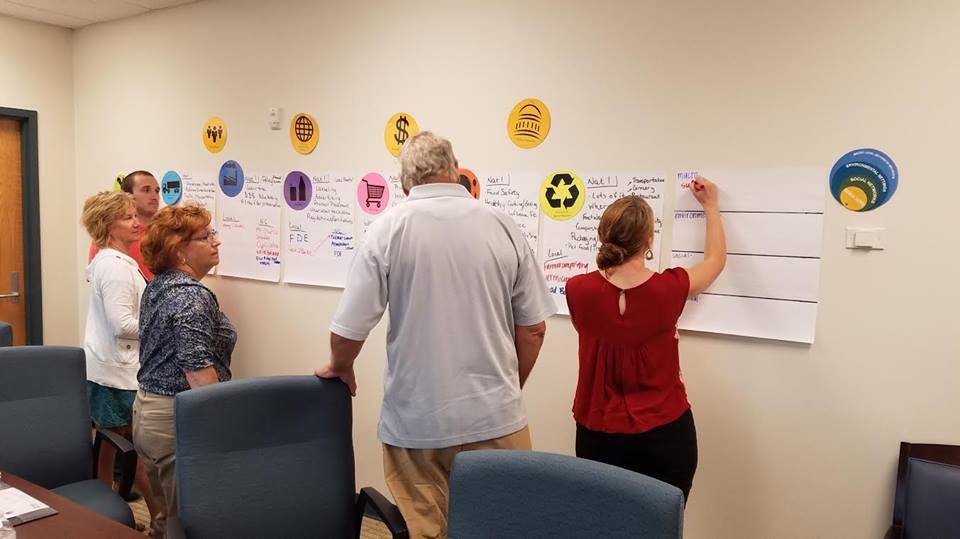
Volunteers will be expected to attend thirty hours of core training, with an additional ten hours of training for elective program support and yearly continuing education. Trainings will include a mixture of on-line and face-to-face formats, and some modules will overlap with the Master Family and Consumer Science Volunteer training. After initial training, volunteers will shadow agents for one year (30 hours), assisting with classes and other activities. After the first year, volunteers will be able to perform some tasks independently, depending on their capacity (please note, due to liability concerns, volunteers will not be allowed to conduct food preservation demonstrations or classes independently). Volunteers will always require some level of agent supervision. Agents will be provided training in the EMFV curriculum, as well as in areas of volunteer recruitment and management. A web-based tool will be used to manage a volunteer calendar and allow volunteers to report their own hours (based on the Extension Master Gardener system).
Who is the EMFV program for?
This program is ideal for volunteers who are interested in formalizing and deepening their training and involvement with Cooperative Extension. This includes the existing volunteer base of the Extension and Community Association (ECA), Master Gardeners, 4-H leaders, and Circles of 10 volunteers with the NC 10% Campaign. In addition, we hope to engage new stakeholder groups, including individuals who are passionate about food, cooking, and local food, as well as community members who participate in Cooperative Extension programs (such as Steps to Health, EFNEP, and Faithful Families Thriving Communities).
What topic areas will the EMFV Program cover?
Core Curriculum (30 hours):
| Program Management/Overview | Nutrition 101 |
| History of Extension & FCS | Food Safety |
| Risk Management | Food Systems & Local Food |
| Teaching Strategies | Cooking Skills |
| Programs that Work | Cooking Demonstrations |
| Changing Health Behaviors |
Continuing Education (10 hours): Continuing education modules will be created to support FCS agents’ work with: farmers’ markets; community/school gardens; food preservation; food pantries; Faithful Families; Steps to Health; EFNEP; and North Carolina seafood.
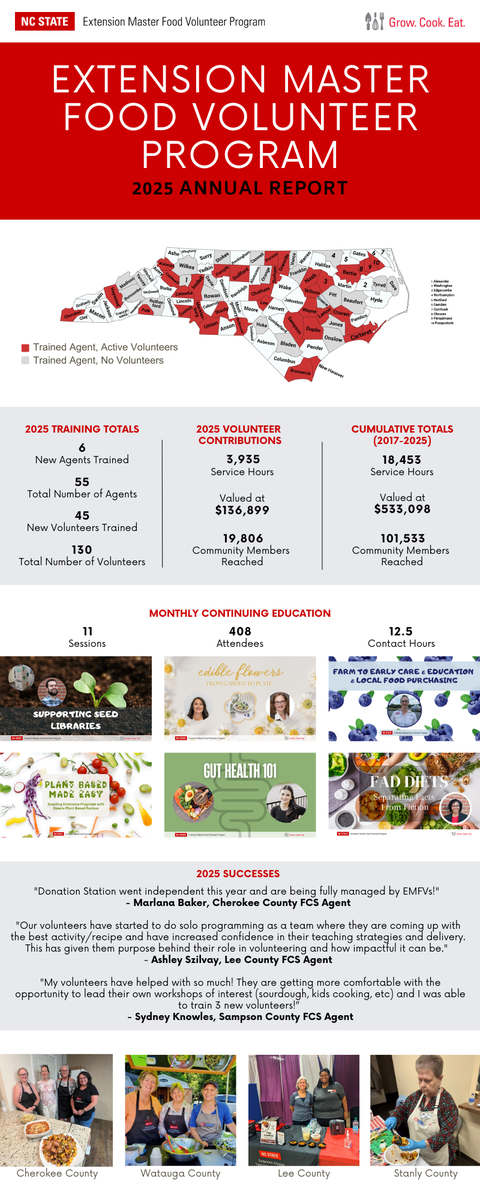
Annual Reports
Further Information
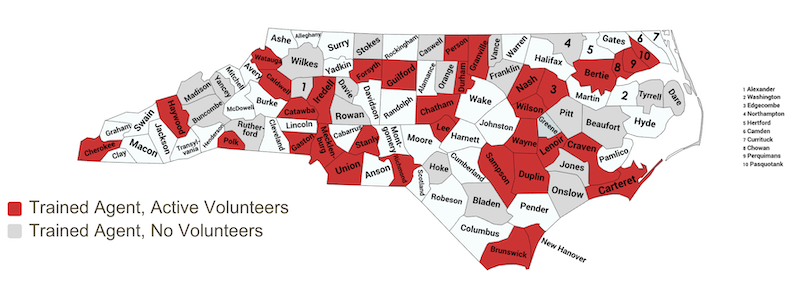
As of December 2025, EMFV representation is shown on the map below. Please use this link to find the county center closest to you, and to find contact information for the Family and Consumer Science Agent offering the program.
Planning Committee
Zandra Alford (Extension Associate); Geri Bushel (ECA Liaison); Dr. Ben Chapman (Associate Professor and Food Safety Specialist); Dr. Carolyn Dunn (Professor and Nutrition Specialist); Dr. Harriett Edwards (Associate Professor and Volunteerism Specialist); Dr. Annie Hardison-Moody (Assistant Professor and Faithful Families Director); Dr. Lindsey Haynes-Maslow Assistant Professor and Extension Specialist); Gretchen Hofing (formerly with Extension); Katrina Levine (Extension Associate); Joanna Massey Lelekacs (formerly with Extension); Robyn Stout (NC 10% Campaign Program Coordinator); Tessa Thraves (Farm to School Coordinator, Extension Associate); Michelle Estrada (FCS Agent, Wayne); Sue Estridge (FCS Agent, Madison, Mitchell, Yancey); Kristin Davis (FCS Agent, Mecklenburg); Tracy Davis (FCS Agent, Rutherford); Jennifer Grable (FCS Agent, Person and Granville); Olivia Jones (Currituck and Camden); Morgan Marshall (FCS Agent, Brunswick, New Hanover, and Pender).
For further information, please contact Morgan Marshall: morgan_marshall@ncsu.edu or Dara Bloom: dara_bloom@ncsu.edu